

Using the wrong amount of fluid can lead to overheating, slipping, harsh shifts, or even transmission failure. This guide provides a detailed fluid capacity chart for nearly all major Allison transmission models, helping you perform fast and accurate maintenance.
Allison Transmission Fluid Capacity Chart
| Transmission Model | Dry Capacity (Quarts) | Initial Fill (Quarts) | Drain & Refill Capacity (Quarts) |
|---|---|---|---|
| Allison 1000 | 17–19 qt | 7.4–8 qt | 7–10 qt |
| Allison 1000 (Deep Pan) | 19–20 qt | 8–9 qt | 8–12 qt |
| Allison 1500 | 18–20 qt | 8–9 qt | 7–10 qt |
| Allison 2000 Series | 17–20 qt | 10 qt | 7–10 qt |
| Allison 2100 | 18–21 qt | 10–11 qt | 8–11 qt |
| Allison 2200 | 18–22 qt | 10–11 qt | 8–11 qt |
| Allison 2300 | 19–22 qt | 11 qt | 8–12 qt |
| Allison 2400 | 19–22 qt | 10 qt | 8–11 qt |
| Allison 2500 | 19–22 qt | 10 qt | 8–11 qt |
| Allison 2550 | 19–23 qt | 10–11 qt | 8–12 qt |
| Allison EVS (Fire/Rescue) | 22–25 qt | 12–14 qt | 10–14 qt |
| Allison 3000 Series | 28–30 qt | 17 qt | 14–17 qt |
| Allison 3000 MH (RV) | 28–31 qt | 17–18 qt | 15–18 qt |
| Allison 3060 | 29–31 qt | 17 qt | 14–17 qt |
| Allison 3070 | 30–33 qt | 17–19 qt | 15–18 qt |
| Allison 3200 | 28–30 qt | 17 qt | 15–17 qt |
| Allison 3300 | 29–32 qt | 18 qt | 15–18 qt |
| Allison B300 | 29–33 qt | 18–22 qt | 15–22 qt |
| Allison S300 | 28–34 qt | 18–21 qt | 14–21 qt |
| Allison 4000 Series | 39–45 qt | 29 qt | 25–29 qt |
| Allison 4000 MH (RV/Coach) | 40–47 qt | 29–33 qt | 26–33 qt |
| Allison 4500 | 42–48 qt | 30 qt | 25–30 qt |
| Allison 4700 | 45–53 qt | 32 qt | 28–32 qt |
| Allison 4800 | 45–55 qt | 32 qt | 28–32 qt |
| Allison B400 | 40–48 qt | 25–32 qt | 20–32 qt |
| Allison S400 | 42–49 qt | 26–33 qt | 22–33 qt |
| Allison 5000 Series | 52–60 qt | 40 qt | 34–40 qt |
| Allison 6000 Series | 55–65 qt | 45 qt | 35–45 qt |
| Allison 6600 | 55–68 qt | 45–50 qt | 35–50 qt |
| Allison 8000 Series | 70–90 qt | 55–65 qt | 45–55 qt |
| Allison 9000 Series | 95–120 qt | 75–85 qt | 60–80 qt |
| Allison AT545 | 16–20 qt | 10 qt | 6–10 qt |
| Allison AT540 | 14–18 qt | 10 qt | 6–9 qt |
| Allison AT1545 | 16–20 qt | 10 qt | 6–10 qt |
| Allison MT643 | 19–24 qt | 12–15 qt | 10–15 qt |
| Allison MT653 | 22–26 qt | 14–16 qt | 11–16 qt |
| Allison MT654 | 22–27 qt | 14–17 qt | 11–17 qt |
| Allison HT740 | 30–36 qt | 26 qt | 20–26 qt |
| Allison HT747 | 34–40 qt | 26–28 qt | 20–28 qt |
| Allison HT750 | 36–42 qt | 28–30 qt | 22–30 qt |
| Allison VR731 (Transit Bus) | 38–45 qt | 24–29 qt | 20–29 qt |
| Allison V730 (GM Transit Bus) | 32–40 qt | 20–25 qt | 15–25 qt |
| Allison CLT/CRT Series (Industrial) | 45–70 qt | 35–50 qt | 25–50 qt |
| Allison Off-Highway (General) | 50–120 qt | 40–90 qt | 30–80 qt |
Related Check Allison Transmission Fluid Level(Step by Step)
Best Allison-Approved Transmission Fluids
1. Castrol TranSynd 668 Full-Synthetic Automatic Transmission Fluid
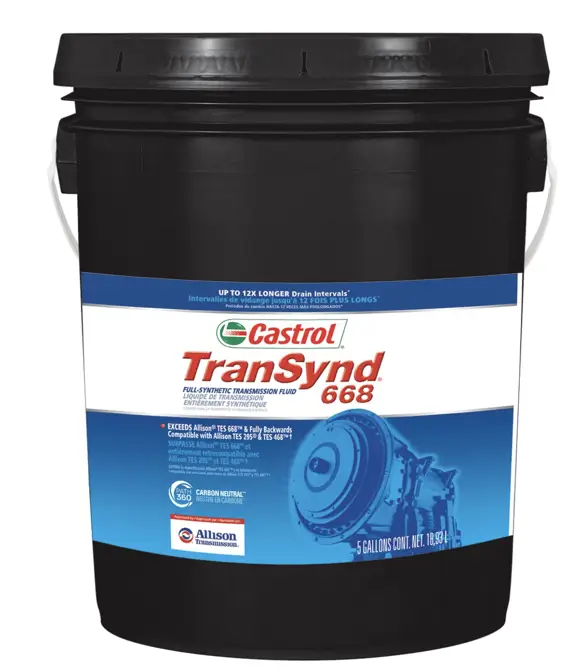
- Fully synthetic formulation designed specifically for Allison automatic transmissions
- Meets Allison TES-668 specification (backward compatible with TES-295)
- Excellent thermal stability for heavy-duty and high-temperature operation
- Helps extend transmission service intervals and component life
- Commonly used in trucks, buses, RVs, and commercial vehicles
2. Mobil Delvac Synthetic ATF (Allison Approved)
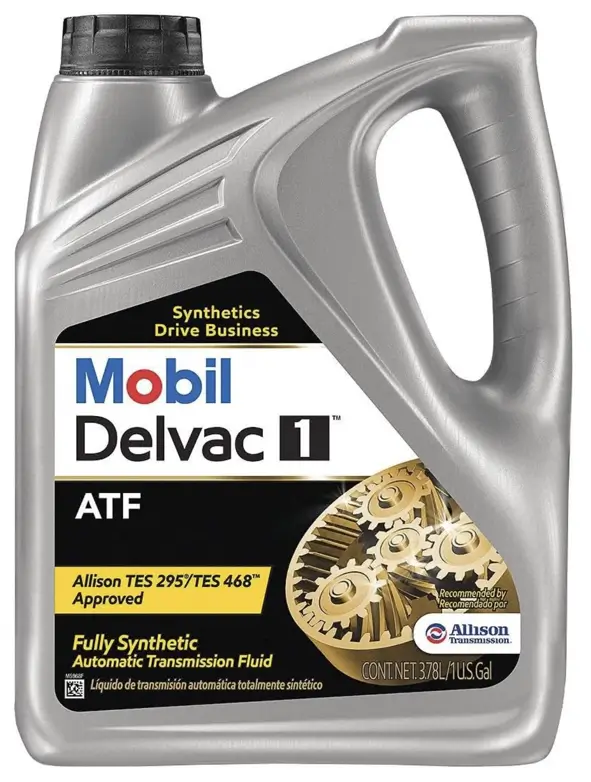
- High-performance synthetic automatic transmission fluid for Allison transmissions
- Approved to Allison TES-295 / TES-668 standards (depending on packaging)
- Provides strong protection against wear, oxidation, and fluid breakdown
- Ensures smooth shifting under heavy loads and demanding conditions
- Suitable for on-highway and vocational heavy-duty applications
3. CITGO Syndurance 668 Synthetic ATF
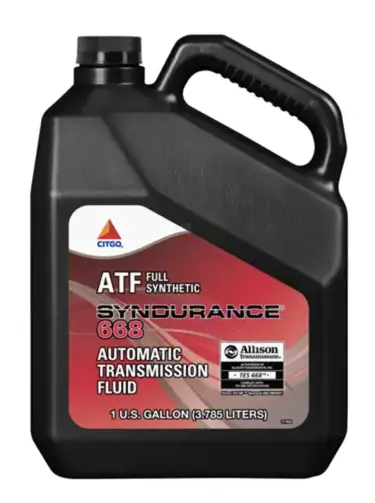
- Fully synthetic ATF approved for Allison TES-668 transmissions
- Backward compatible with older Allison TES-295 requirements
- Excellent shear stability for long-drain service intervals
- Helps reduce transmission heat and maintain consistent shift quality
- Designed for commercial trucks, buses, and severe-duty service
Related Transmission Fluid for Allison 1000(Top 5 Best Picks 2026)
What Affects Allison Fluid Capacity?
Fluid capacity can differ depending on:
1. Pan Depth
Shallow pans hold less fluid; deep pans or aftermarket pans increase capacity.
2. Filter Type
Some models use internal filters plus external spin-on filters that add extra volume.
3. Cooler Lines & Radiators
Longer or larger coolers add fluid capacity.
4. Application (Truck vs Bus vs Industrial)
Commercial buses often use larger coolers and extended pans.
5. Dry vs Wet Capacity
- Dry capacity = completely empty transmission (after overhaul).
- Drain & fill capacity = only a portion of the fluid exits during a standard service.
Related Transmission Fluid Temperature Chart(Complete Guide)
Recommended Fluid Types for Allison Transmissions
Allison recommends using TES-295 or TES-668 approved fluids for maximum protection.
TES-295 (Synthetic)
- Longest drain intervals (up to 300,000 miles in some cases)
- Best performance and heat resistance
- Examples: Transynd, Mobil Delvac Synthetic ATF
TES-668 (Newer Standard)
- Improved thermal stability
- Enhanced clutch material compatibility
- Backward compatible with TES-295
DEXRON III / HD ATF (Non-synthetic)
- Acceptable for older models like AT/MT/HT series
- Shorter change intervals
Related Automatic Transmission Fluid Color Chart(All Colors)
How Often Should You Change Allison Transmission Fluid?
| Use Case | TES-295 Synthetic Interval | Conventional ATF Interval |
|---|---|---|
| Normal Duty | 150,000–300,000 miles | 25,000–50,000 miles |
| Severe Duty | 75,000–150,000 miles | 15,000–25,000 miles |
| Off-Highway | Hours-based | Hours-based |
FAQs
How much fluid does my Allison transmission hold?
The fluid capacity depends on your specific Allison model, pan depth, and whether you’re doing a drain-and-fill or a complete dry fill.
- Allison 1000/2000 Series: 7–10 qt (drain & fill), 17–20 qt (dry).
- Allison 3000 Series: 14–17 qt (drain & fill), 28–30 qt (dry).
- Allison 4000 Series: 25–29 qt (drain & fill), 39–45 qt (dry).
- Consult your transmission tag or owner’s manual for exact configurations.
What kind of fluid does an Allison 3000 transmission take?
The Allison 3000 Series is designed to use Allison-approved TES-295 or TES-668 synthetic ATF, such as:
- Transynd (TES-295)
- Mobil Delvac Synthetic ATF
- Castrol TranSynd
- These fluids offer superior heat resistance, longer shift performance, and extended service intervals. Conventional ATF is not recommended in modern 3000 Series transmissions.
What is the capacity of the Allison 4000 transmission?
The typical fluid capacity for an Allison 4000 Series is:
- Drain & Refill: 25–29 quarts
- Dry Capacity: 39–45 quarts
- This varies depending on cooler size, pan depth, and external filter configuration. Vehicles like fire trucks and heavy vocational rigs often sit at the higher end due to larger cooling circuits.
What is the capacity of the Allison 3000 transmission?
The Allison 3000 Series generally holds:
- Drain & Refill: 14–17 quarts.
- Dry Capacity: 28–30 quarts
- Exact capacity varies by model (3000, 3060, 3070, B300, S300) and cooler line routing.
How to check Allison transmission fluid level?
Use one of the following methods depending on your model:
1. Using the Shift Selector (Most Common Method)
- Park on level ground.
- Bring the transmission to operating temp (160–200°F).
- Put the transmission in Neutral and apply the parking brake.
- Press the UP and DOWN arrows together on the Allison shift pad.
- Wait for the display to show “oL” (oil level).
- The screen will show “OK,” “Lo,” or “Hi” along with how many quarts you are off.
2. Using the Dipstick (Older Models)
- Warm up the transmission.
- Leave engine idling in Neutral.
- Pull the dipstick, wipe it, reinsert, and pull again.
- Fluid should be between “HOT RUN” marks.
Make sure to use only Allison-approved ATF for accurate readings and performance.
Final Thoughts
Servicing an Allison transmission is easy when you have accurate fluid capacity information. The chart above covers the most widely used models in the 1000 through 9000 series, along with AT/MT/HT units that remain popular in older trucks and buses.
Whether you’re maintaining a personal RV or managing a fleet of vocational trucks, correct fluid levels, TES-approved fluids, and timely service will keep your Allison transmission running smoothly for years.